Certificate Transparency
Certificate Transparency (CT) is a system of public, append-only logs where certificate authorities record the TLS certificates they issue. Anyone can read the logs, so a domain owner can notice a certificate issued for their name that they did not request, and browsers can demand proof that a certificate was logged. It makes misissuance detectable, but it does not prevent it.
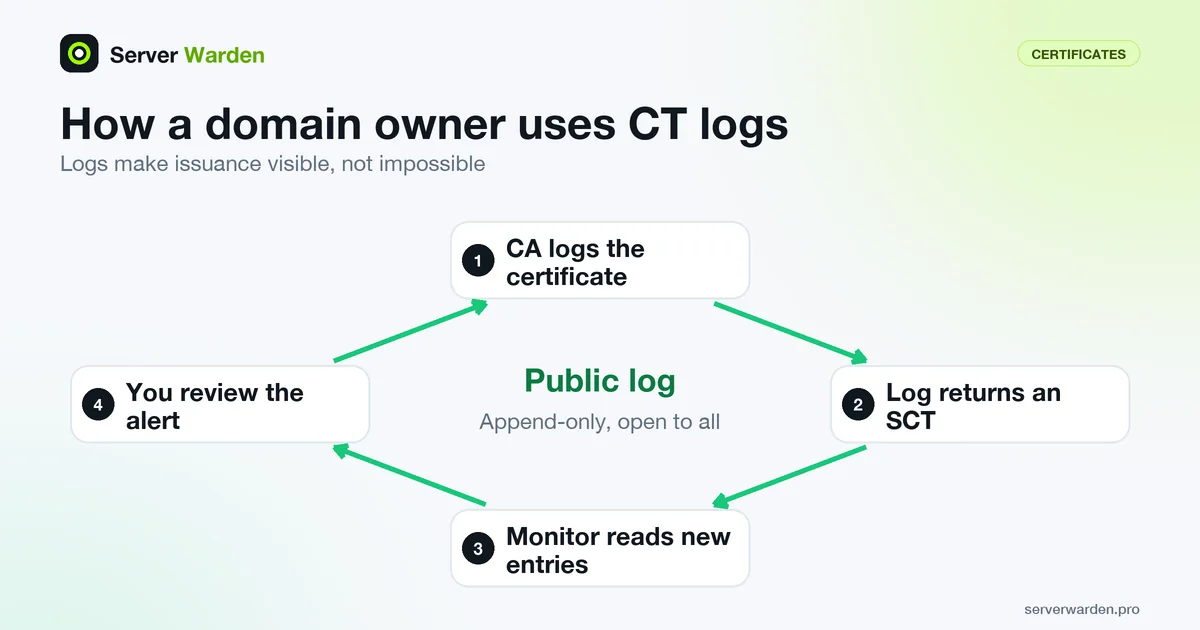
How the logs work
The protocol is defined in RFC 6962 (2013), and RFC 9162 (2021) describes version 2.0 and obsoletes it. Both carry the Experimental status. Each log is a single, ever-growing Merkle tree of certificates, so a log cannot quietly remove or rewrite an entry without the change being detectable. Anyone can submit a certificate, but a chain must lead to a CA the log accepts.
When a certificate is submitted, the log returns a Signed Certificate Timestamp (SCT). The RFC calls the SCT the log's promise to include the certificate within a fixed period, the Maximum Merge Delay. Two roles check the system: monitors watch logs for new entries and certificates of interest, and auditors verify that logs behave consistently.
Public CAs submit what they issue. Let's Encrypt states that it submits all certificates it issues. The result is a public record of the names covered by each certificate, which underpins TLS trust on the open web.
What reaches the browser: SCTs and Chrome policy
RFC 6962 lets a server deliver the SCT in three ways: an X.509 extension inside the certificate, a TLS extension, or OCSP stapling. A CA can embed the SCTs in the certificate, and RFC 6962 notes that existing servers can use that mechanism without modification, so most site owners never touch CT directly.
Browsers decide whether to enforce it. Chrome's published CT policy says publicly trusted certificates must be CT compliant, or they fail to validate. For embedded SCTs it asks for at least one from a log in an acceptable state, SCTs from at least two distinct logs for a certificate valid up to 180 days and three for longer, and at least two of them from different log operators.
That policy is why a CA that wants its certificates to work in Chrome must log them. A certificate from a private CA is outside this regime, since the policy speaks about publicly trusted certificates. Check your own CA's behaviour if you run an internal one.
Watching your own domain
The protection comes from people reading the logs. RFC 6962 says logs do not themselves detect misissuance and rely on interested parties such as domain owners to monitor them. That means you subscribe to a monitor for your domain and review what it reports.
One option is Cloudflare's opt-in Certificate Transparency Monitoring. Alerts are off by default. After you enable it and add an email address, Cloudflare mails the issuer, DNS names and validity dates whenever a certificate for your domain is logged, and it filters out certificates Cloudflare itself issues for you. Its docs say it alerts on all new certificates, not only unexpected ones, may mention unrelated names on a shared certificate, and does not detect phishing from lookalike domains.
Open source monitors such as Cert Spotter do the same from your own server, as the subdomain enumeration entry describes. We did not run any monitor, because they contact public services, so this part is from the documentation, not our tests.
Limits, privacy and what to do with an alert
CT detects, it does not prevent. RFC 6962 says logs do not stop misissue, and that an SCT is not a guarantee a certificate was properly issued, since the owner may not have checked the logs or the CA may refuse to revoke it. When an alert shows a certificate you did not request, contact the issuer named in it: Cloudflare's docs state that only certificate authorities can revoke a malicious certificate. Treat it as an incident.
The same openness has a privacy side. Every name in a logged certificate is public. Let's Encrypt notes that crawling bots can discover a domain shortly after its certificate is submitted. Do not put internal hostnames into public certificates, and expect staging and admin names to be found. That is exactly why certificate logs feed subdomain enumeration and widen your attack surface view.
Finally, CT says nothing about whether the server behind a name is secure. It tells you a certificate exists, not that the host is safe.
Related terms: TLS/SSL, Subdomain enumeration, Attack surface, HSTS, Incident response.
Frequently asked questions
What is Certificate Transparency in simple terms?
It is a set of public logs where certificate authorities record every TLS certificate they issue. Anyone can read them, so a certificate nobody expected can be noticed.
What is the difference between RFC 6962 and RFC 9162?
RFC 9162 is Certificate Transparency version 2.0 and obsoletes RFC 6962. Both carry the Experimental status.
Does Certificate Transparency stop a fraudulent certificate?
No. The logs make misissuance visible, but they do not block it. Someone has to watch the logs and ask the CA to revoke what is wrong.
What is a Signed Certificate Timestamp?
It is the log's signed promise to include a certificate in its tree within the Maximum Merge Delay. It is delivered inside the certificate, as a TLS extension or by OCSP stapling.
Are my subdomain names public if I get a certificate?
Yes. Every name in a publicly logged certificate can be read by anyone. Avoid putting internal hostnames in public certificates.
Want to see where your own server stands?
Run the free, read-only server check, or open the Security Lab and watch the detect, contain, recover, verify loop in action.
Get your free server checkOpen the Security Lab